
How Does Computerized Frame Alignment Work After Vehicle Damage?
Introduction
A vehicle can look surprisingly normal after a collision while still having structural damage that affects how it drives and protects its occupants. A bent frame or unibody structure may not always be obvious from the outside. That is why modern collision repair often goes beyond replacing visible parts and repainting damaged panels.
Computerized frame alignment is a measurement-based repair process used to determine whether a vehicle's structural dimensions have changed after an accident. Technicians use specialized measuring equipment and manufacturer specifications to identify deviations, determine where correction is needed, and verify the structure after repairs.
The goal is not simply to make a damaged vehicle look straight. Proper structural repair is about restoring the vehicle as closely as practical to the dimensions and repair procedures specified by its manufacturer.
For drivers dealing with collision damage, understanding how computerized frame alignment works can make the repair process much easier to follow. It also explains why a professional collision repair estimate may involve structural measurements even when the most visible damage appears to be a dented bumper, crushed fender, or damaged door.
What Is Computerized Frame Alignment?
Computerized frame alignment is a collision repair process that uses electronic or computerized measuring equipment to compare a vehicle's actual structural dimensions with reference measurements supplied by the vehicle manufacturer or an approved repair information system.
The term "frame alignment" can be slightly misleading because not every modern vehicle has a traditional separate frame. Many passenger cars use a unibody construction, in which major structural components are integrated into the vehicle body. Trucks and some SUVs may use a separate frame.
Regardless of construction, the basic principle is similar: technicians measure important structural points and determine whether those points remain within the appropriate specifications.
Why Structural Measurements Matter
A collision can move structural components in several directions. A vehicle may have been pushed sideways, compressed from the front or rear, shifted diagonally, or affected in multiple areas at once.
Visual inspection alone cannot reliably identify every dimensional change.
Computerized measuring systems can help technicians identify:
Structural points that have moved from specification
Differences between corresponding measurement points
Changes in length, width, height, or diagonal measurements
Areas requiring controlled correction
Whether completed repairs return measurements to the required specifications
The measurements provide objective information that supports the repair process.
How Does Computerized Frame Alignment Work?
Although equipment and procedures vary between collision repair facilities, computerized structural measurement generally follows a sequence of inspection, measurement, correction, and verification.
Step 1: The Vehicle Is Inspected
Before structural measuring begins, technicians inspect the vehicle and document collision damage.
This may include checking exterior panels, suspension components, wheels, tires, doors, hood, trunk or liftgate, glass, underbody areas, and other components that may have been affected.
A vehicle can have hidden damage behind apparently minor exterior damage. The initial inspection helps determine whether more detailed structural measurement is warranted.
For a broader look at this initial process, see what happens during a professional collision damage assessment.
Step 2: The Vehicle Is Positioned for Measurement
The damaged vehicle must be placed securely and correctly on the appropriate collision repair equipment.
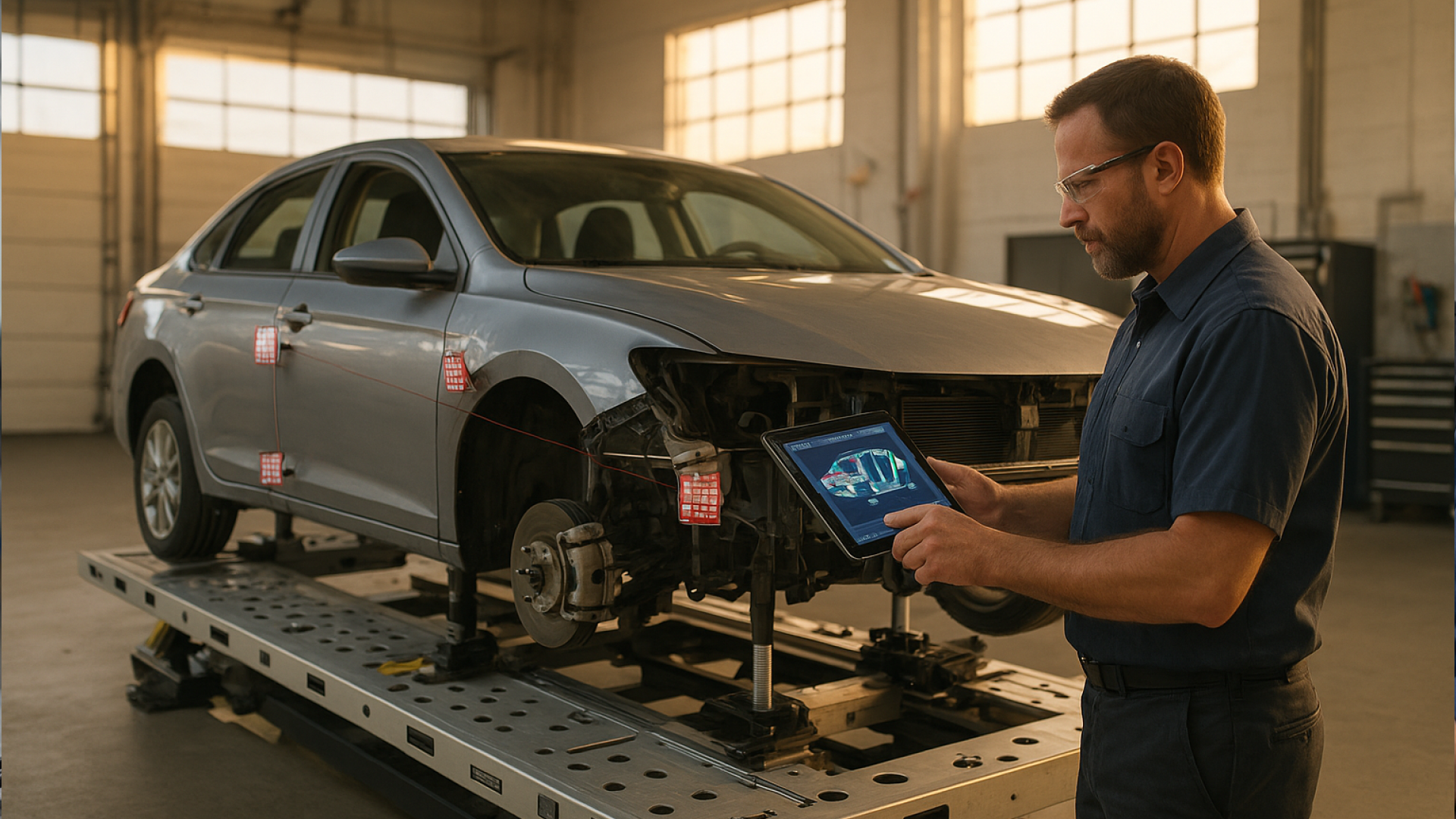
Depending on the vehicle and repair system, technicians may use a frame machine, dedicated measuring system, electronic targets, sensors, laser-based equipment, or other approved measurement technology.
Correct positioning matters because inaccurate setup can affect the measurements.
Step 3: Reference Points Are Selected
Technicians identify structural measurement points specified by the vehicle manufacturer or the measuring system being used.
These points can include locations on the vehicle's frame or unibody structure. The system establishes relationships between these points so technicians can determine whether the structure has moved.
A measurement is more useful when it is compared with a known specification rather than judged simply by eye.
Step 4: The Computerized System Measures the Structure
The measuring equipment collects dimensional information from selected points.
Depending on the system, measurements may be displayed digitally and compared with reference data. The technician can see where dimensions differ from the expected specifications.
This provides a clearer picture of the structural condition than relying solely on visual inspection.
Step 5: Technicians Interpret the Results
A measurement result does not automatically tell the technician to pull or push a particular component.
The technician must consider the collision damage, manufacturer repair procedures, material type, deformation pattern, and other relevant factors.
This is where technician expertise matters. Computerized equipment provides measurements, but trained professionals still have to interpret those measurements and determine the appropriate repair procedure.
Step 6: Structural Correction Is Performed
If the vehicle's structure is repairable and measurements show that correction is necessary, the vehicle may be secured to a frame or structural repair system.
Controlled force can then be applied according to the appropriate repair procedure.
The objective is to restore the affected structural areas to the required dimensions without causing additional damage. Not every damaged structural component should simply be pulled back into position. Some parts may require replacement when manufacturer procedures call for replacement rather than straightening.
Step 7: Measurements Are Checked Again
After structural correction or replacement, technicians can measure the vehicle again.
This post-repair measurement helps verify whether the relevant structural points have returned to the specified dimensions.
The before-and-after comparison is valuable because it provides documented evidence of the structural repair process.
What Is the Difference Between a Frame and a Unibody?
Understanding the vehicle's construction helps explain why collision repair terminology can vary.
Traditional Frame Construction
A traditional body-on-frame vehicle has a separate structural frame that supports major vehicle components, with the body mounted to the frame.
This design is commonly associated with many trucks and certain SUVs.
When this type of vehicle is involved in a collision, technicians may inspect and measure the frame for bending, twisting, or other deformation.
Unibody Construction
Many modern passenger vehicles use unibody construction.
Instead of relying on one separate frame, the body structure incorporates multiple interconnected structural sections. These areas are engineered to provide rigidity and manage crash forces.
That means collision repair technicians may be measuring unibody structural dimensions rather than aligning a conventional frame.
The repair principle remains the same: identify dimensional changes and follow the appropriate manufacturer repair information.
What Equipment Is Used for Computerized Frame Alignment?
Modern collision repair facilities may use different types of structural measuring equipment.
Electronic Measuring Systems
Electronic systems can measure selected points and provide digital dimensional information.
They can help technicians identify differences between the vehicle's current position and reference specifications.
Laser Measuring Systems
Some systems use lasers to measure structural points.
Laser technology can allow technicians to evaluate multiple dimensions and identify deviations that may not be apparent visually.
Frame Machines
A frame machine or structural repair bench can secure the vehicle while controlled correction is performed.
The machine itself does not replace measurement. Proper measuring procedures are still necessary to understand what needs to be corrected.
Manufacturer Repair Information
Equipment is only one part of the process.
Vehicle manufacturers publish repair procedures and dimensional information for many models. Collision technicians need access to appropriate repair information to determine how a particular vehicle should be inspected, repaired, measured, or replaced.
Why Can't Technicians Just Look at the Vehicle and Tell If the Frame Is Bent?
A visual inspection is an essential part of collision repair, but it has limitations.
Structural damage can occur underneath exterior panels, behind bumpers, or in areas that are difficult to see without disassembly.
A vehicle can also have dimensional changes that are small enough to escape visual detection but significant enough to affect suspension geometry, panel fit, steering behavior, or crash-related structural performance.
Computerized measuring provides another layer of information.
Think of it as the difference between looking at a crooked picture frame on a wall and actually measuring the wall and frame with precise tools. Your eyes may identify a problem, but measurements help establish exactly where and how much the structure has moved.
What Problems Can Incorrect Frame Alignment Cause?
Structural dimensions influence more than the appearance of a vehicle.
If collision damage is not properly diagnosed or repaired, potential problems can include:
Uneven panel gaps
Difficulty closing doors, hood, or trunk
Steering or handling concerns
Alignment problems
Uneven tire wear
Vehicle pulling to one side
Suspension geometry issues
Abnormal noises or vibration
Difficulty completing subsequent repairs correctly
The exact consequences depend on the location and severity of the damage.
A vehicle that drives reasonably well immediately after a crash should not automatically be assumed to have an undamaged structure.
For additional context, see how frame misalignment can affect your car's handling and safety.
Is Frame Alignment Necessary After Every Accident?
No. Not every collision requires structural alignment.
A low-speed impact may damage only a bumper cover or exterior panel. In other cases, a collision that appears relatively minor may affect components underneath the visible damage.
Whether computerized structural measurement is appropriate depends on factors such as:
Collision direction
Impact severity
Location of the impact
Visible deformation
Suspension or wheel damage
Panel fit
Manufacturer repair procedures
Results of the collision inspection
A qualified collision repair technician can determine whether structural measurement is appropriate after inspecting the vehicle.
What Happens If a Vehicle Cannot Be Straightened?
Structural repair does not always mean pulling a damaged component back into shape.
Some vehicle structures or components are designed to be replaced rather than straightened after certain types of damage. This is particularly important with modern vehicles that use different grades and types of metals, adhesives, welds, and engineered structural sections.
Technicians should follow the vehicle manufacturer's repair procedures when determining whether a component can be repaired or needs replacement.
The safest repair decision is based on the vehicle's construction, damage, repair information, and applicable procedures rather than a one-size-fits-all approach.
How Computerized Frame Alignment Supports Collision Repair
Computerized measurement is valuable because it turns part of the structural repair process into a measurable comparison.
It Helps Identify Hidden Structural Changes
Exterior damage does not always tell the whole story. Measuring structural points can reveal changes that require attention.
For more information, see how hidden damage can affect your vehicle after an accident.
It Supports Accurate Repairs
A technician can use measurements to understand the extent and direction of structural movement before performing corrective work.
It Helps With Quality Control
Post-repair measurements can help verify whether the repaired structure meets the applicable dimensional requirements.
It Supports Documentation
Measurement information can become part of the repair documentation, depending on the repair facility's procedures and documentation practices.
Common Misconceptions About Frame Alignment
"If the Car Drives Straight, the Frame Must Be Fine"
Not necessarily. A vehicle can drive acceptably while still having structural or dimensional damage.
"Frame Alignment Means Every Vehicle Gets Pulled on a Machine"
No. The repair method depends on the vehicle's construction, damage, and manufacturer procedures. Some components may need replacement rather than straightening.
"Computerized Equipment Does the Repair Automatically"
The equipment measures. Trained technicians interpret the results and perform the repair.
"A Small Dent Means There Is No Structural Damage"
Not always. Damage assessment depends on the location, impact, and vehicle structure.
"Frame Repair Is Only About Making the Vehicle Look Straight"
Structural repair is about restoring the vehicle according to appropriate repair specifications, not simply improving its appearance.
What Should You Ask a Collision Repair Shop About Frame Alignment?
If your vehicle has sustained significant collision damage, a few straightforward questions can help you understand the repair plan.
Ask:
Was the vehicle structurally measured?
Were manufacturer specifications used?
Was any structural damage found?
Which components are being repaired or replaced?
Will measurements be taken again after structural repairs?
Are there manufacturer-specific repair procedures for this vehicle?
Will the final repair documentation include structural measurement information?
These questions can help you understand what is happening behind the visible bodywork.
How Frame Alignment Fits Into the Overall Collision Repair Process
Structural measurement is only one part of a complete collision repair.
A typical repair may involve:
Initial inspection and damage documentation
Disassembly to identify hidden damage
Structural measurement
Structural repair or component replacement
Suspension and mechanical inspection
Body panel replacement or repair
Surface preparation
Paint and refinishing
Glass or other component replacement when necessary
Reassembly
Calibration of applicable electronic safety systems
Final inspection and quality checks
The exact sequence varies according to the vehicle and collision.
Modern vehicles can contain cameras, radar sensors, parking sensors, driver-assistance systems, and other technology that may require inspection or calibration after certain repairs. That is another reason collision repair should be treated as more than a cosmetic process.
For additional information about structural restoration, see how collision repair helps restore structural safety to your vehicle.
Practical Takeaways for Vehicle Owners
If your vehicle has been involved in a collision, keep these points in mind:
Visible damage does not always reveal the full extent of structural damage.
Computerized measurement can identify dimensional changes that are difficult to see.
Manufacturer specifications are an important part of structural repair.
Not every damaged vehicle needs frame straightening.
Some structural components may need replacement instead of repair.
Measurements before and after structural work can help verify the repair.
Proper collision repair involves structural, mechanical, electrical, and cosmetic considerations.
Ask the repair facility to explain any structural damage and the procedures being used.
Understanding these basics can make collision estimates and repair discussions much less confusing.
Conclusion
Computerized frame alignment gives collision repair technicians a more precise way to evaluate vehicle structure after an accident. Instead of relying entirely on visual inspection, the process uses measured structural points and applicable manufacturer specifications to identify dimensional changes and guide repairs.
The process generally involves inspecting the vehicle, positioning it correctly, measuring structural points, comparing those measurements with reference data, making appropriate corrections or replacements, and measuring the structure again after the repair.
The technology is important, but the technician's judgment remains just as significant. A computerized system can provide measurements, but experienced collision professionals must interpret those measurements and follow the repair procedures appropriate for the vehicle.
For vehicle owners, the key takeaway is simple: collision repair is not only about fixing what you can see. Proper structural assessment helps determine whether the vehicle's underlying dimensions have been affected and whether the necessary repairs have been completed according to appropriate specifications.
Frequently Asked Questions
What is computerized frame alignment?
Computerized frame alignment is a structural measurement and repair process that uses specialized equipment to compare a vehicle's structural dimensions with applicable reference specifications. It helps technicians identify structural movement after a collision and verify measurements during the repair process.
How do you know if a car frame is bent after an accident?
A bent or damaged structure may produce symptoms such as uneven panel gaps, doors that do not fit correctly, alignment problems, unusual tire wear, or handling concerns. However, some structural damage may not be obvious from symptoms alone. Professional structural measurement can provide more reliable information.
How long does computerized frame alignment take?
The time varies according to the vehicle, extent of damage, accessibility of measurement points, and required repairs. Measuring the structure may be only one stage of a larger collision repair process, so the total repair time can be considerably longer.
Can a bent frame be repaired?
Some structural damage can be repaired when the vehicle manufacturer permits that repair method. Other damaged components may need replacement. The appropriate approach depends on the vehicle's construction, the location and severity of the damage, and manufacturer repair procedures.
Does frame damage affect wheel alignment?
It can. Structural damage may change the position of suspension mounting points or other components that influence wheel alignment. A vehicle may require both structural measurement and a wheel alignment after certain collisions.
Is computerized frame measurement better than a visual inspection?
They serve different purposes. Visual inspection helps technicians identify obvious damage and determine where further investigation is needed. Computerized measurement provides dimensional information that cannot always be established through visual inspection alone.
Does every accident require frame alignment?
No. Minor collisions may involve only cosmetic or bolt-on component damage. Structural measurement may be appropriate when the collision, visible damage, vehicle construction, or manufacturer repair procedures indicate a possibility of structural movement.
Can frame damage be hidden?
Yes. Structural damage can occur behind exterior panels or in areas that are not immediately visible. This is why collision inspections sometimes involve disassembly and structural measurement.
What happens after frame alignment?
After structural correction or replacement, technicians may perform additional measurements to verify the repaired dimensions. The vehicle can then proceed through other necessary collision repairs, which may include suspension work, body repairs, refinishing, reassembly, and applicable electronic system inspections or calibrations.
Why are manufacturer specifications important for frame alignment?
Vehicle structures are engineered to specific dimensions and repair methods. Manufacturer repair information helps technicians determine the appropriate measurement points, repair methods, replacement requirements, and other procedures for a particular vehicle.
